
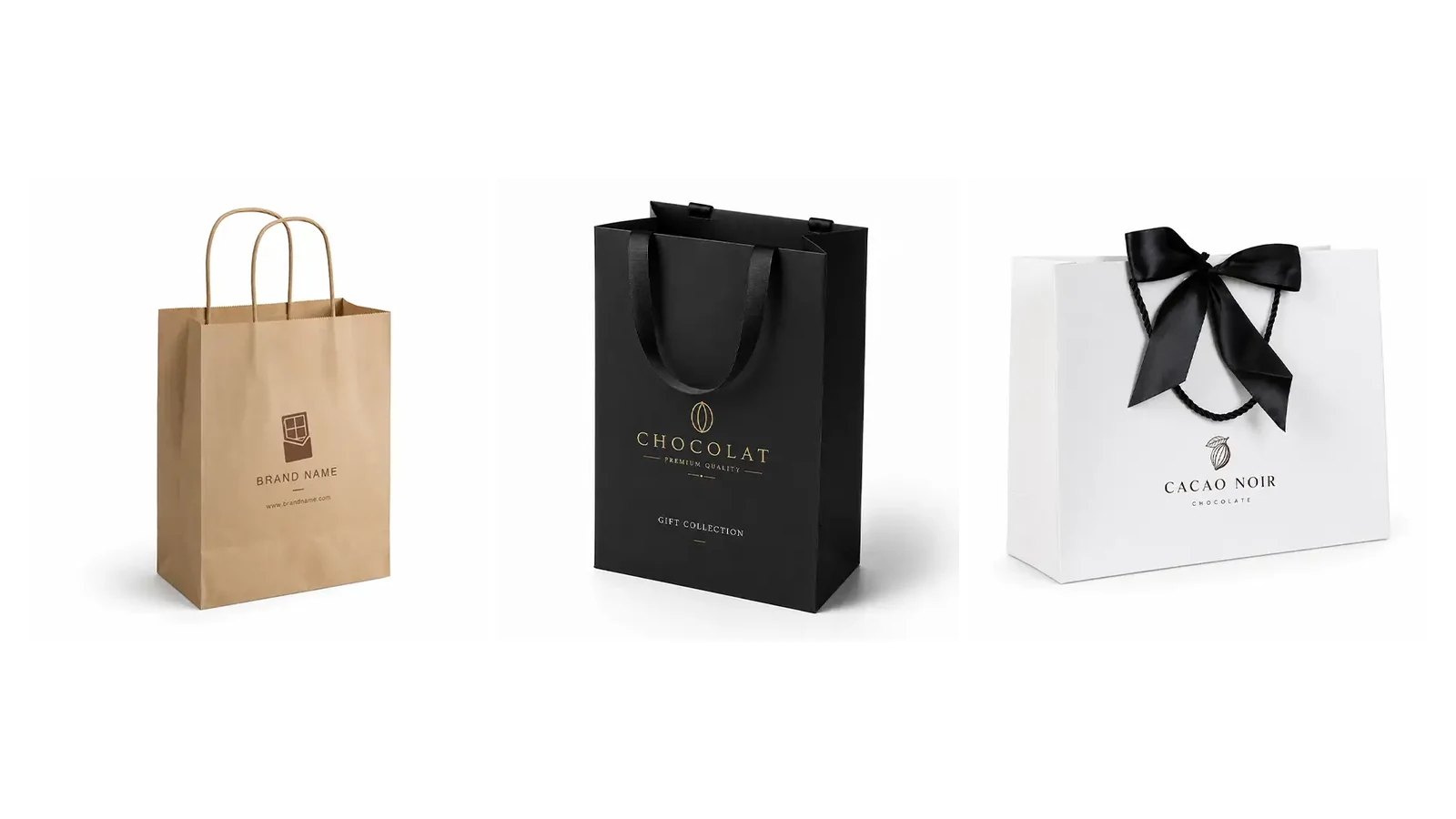
For most chocolate shops, a practical starting range is a compact bag for wrapped bars and small boxes, an everyday carry bag for mixed orders, and a wider bag for gift boxes that need to lie flat. Start with the orders you actually sell. A tall shopping bag can hold a stack of bars and still be too shallow for one box of bonbons. Adding height will leave that box with the same problem.
First decide how the chocolate needs to sit and measure the packed order. Then check how the bag feels when carried and how it looks at the counter. The examples below show several ways to solve those different jobs.
Match the bag to the order
| What goes in the bag | A useful starting point | What to check |
|---|---|---|
| One or two wrapped bars | Flat paper sleeve or compact carry bag | Can staff slide the bars in smoothly? Is a handle useful for this purchase? |
| Small boxed favors and event handouts | Compact bag with a cutout handle and folding flap | Does the flap close comfortably, and can customers get a good grip? |
| Bars, pouches, and small boxes in one order | Flat-bottom bag with flat or twisted paper handles | Can the heaviest item sit on the base without pressing into the lighter packs? |
| One flat box of bonbons or truffles | Low, wide bag with enough front-to-back depth | Can the customer carry the box level and lift it out without catching the lid? |
| Several gift boxes or a chocolate hamper | Wide-base bag with a sample-approved bottom and handle assembly | Does the full order remain stable when lifted, carried, and set down? |
Sort a recent run of orders by the finished packs that leave the shop together. Try those combinations in a few stock bags before requesting custom sizes. You may find that one everyday size covers two common orders, while one shallow, wide box needs its own bag because it must stay level.
If you're still deciding which assortments to sell in folding cartons and which to offer in larger gift boxes, settle that mix first. The boxes your team hands to customers will determine which bags you need. Choosing folding boxes and gift boxes for a chocolate shop
Compare the handles customers will actually use
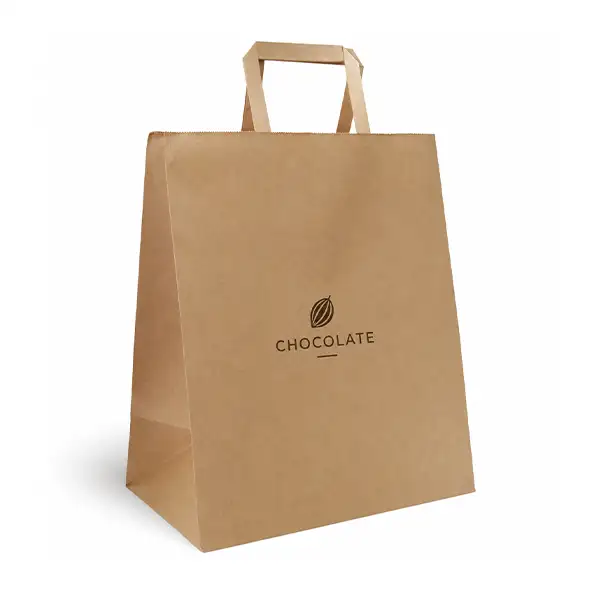
Flat paper handles for quick counter service
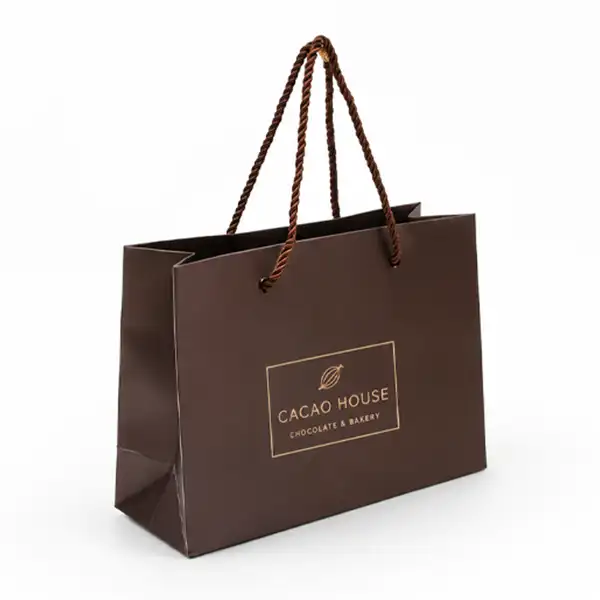
A flat paper handle is a folded strip of paper. On a bag that opens easily and stands on its base, staff can load a box with both hands and then bring the handles together for the handoff. Try this style for everyday purchases at a busy counter. On the sample, check where the handle ends are glued and whether the handle opening feels comfortable with the normal order inside.
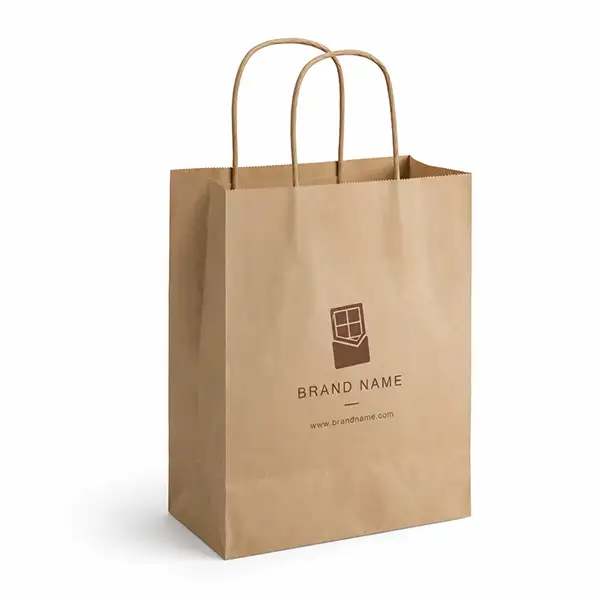
Twisted paper handles for mixed retail orders
Twisted paper handles form round loops that usually project above the bag opening. They are a useful option for a shop that sells bars, pouches and small assortments together. Check how readily staff can separate the handles while loading, and how the loops feel on the fingers at the heaviest planned order. Compare both paper-handle choices at the same dimensions and with the same contents.
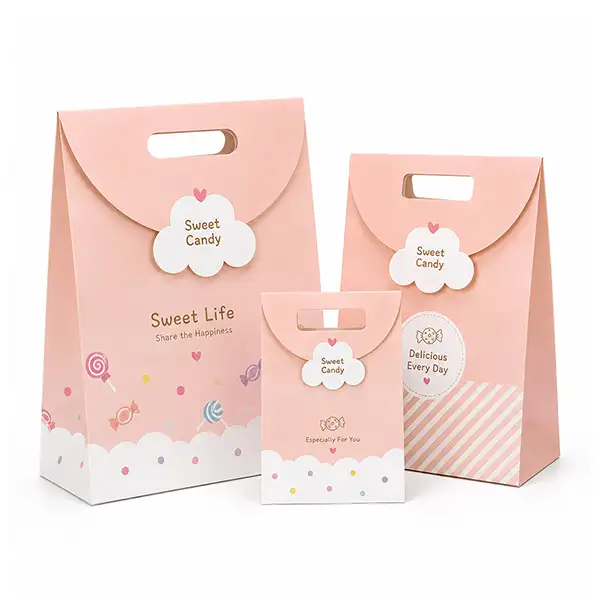
Cutout handles and flaps for small favors
A cutout handle is a grip cut into the top panel. Some bags combine it with a folding flap, so the pack looks ready to give when it leaves the counter. Use a physical sample for favors, small boxed assortments or event handouts. Put the actual pack inside and make sure the flap sits flat, the handle holes line up, and the customer's fingers have room. For loose chocolates, choose the food-contact inner pack separately.
Rope, ribbon, and decorative closures for gift orders
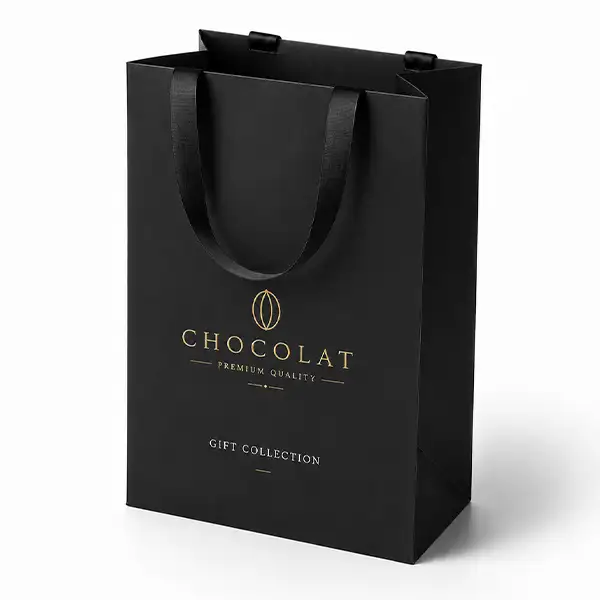
Rope and ribbon change the way a bag feels in the hand and how the gift is presented. Try both on the actual order. Flat ribbon can spread across the fingers, but its width, attachment and finish determine how it behaves. Rope should feel comfortable under load, and its knots or fittings need to stay clear of the box corners. Ask for the same handle attachment on the sample that you will get in production.
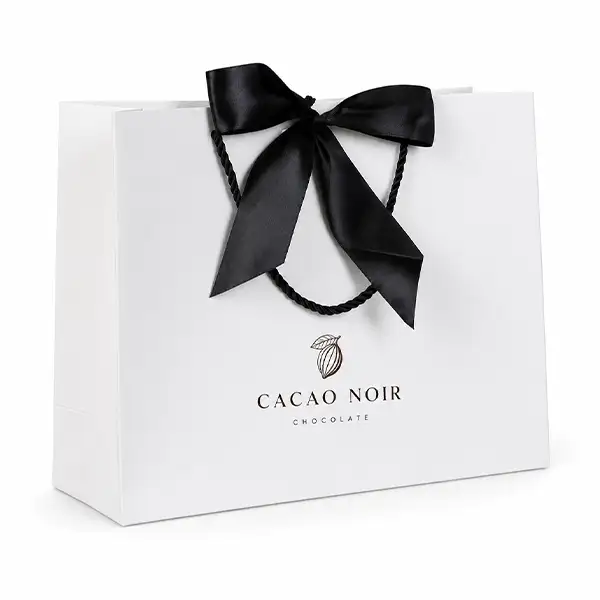
A bow adds another decision for a busy shop. If it is tied at checkout, have staff time a few normal packs and reopen one to check the result. If it comes pre-tied, ask how it ships and how staff will keep it from creasing in storage. If you want a simpler handoff, try a contrasting ribbon handle that staff can pick up and hand over directly.
Measure the bag around the packed chocolate
Measure the outside of the closed box or the whole group of items as carried. Include anything that sticks out, such as a lid edge, sleeve, bow or message card. Record the dimensions and weigh the complete order. For a handled bag with side folds, this guide uses width × gusset × height. Width is across the front panel, gusset is the depth when the bag opens, and height is the bag body from the base to the rim. Label each number and confirm with the supplier whether it describes the outside or usable space. Suppliers use different sequences. Paper bag measuring guide
Work out the footprint before adding height
Say your closed bonbon box measures 240 × 175 × 45 mm. Carried face up, it needs a usable base and an opening that accept a 240 × 175 mm rectangle with room for insertion and removal. A nominal bag that is 260 mm wide, 120 mm deep, and 300 mm tall is too shallow for that orientation. The box needs depth even though it is only 45 mm high. Also check that the seams, inward folds and handle fasteners leave enough room for the corners to pass through. Guide to opened bag dimensions
For two identical boxes stacked level, the footprint stays 240 × 175 mm and the stack reaches 90 mm before extras. The combined weight also rises. Try the stack in the sample and see if the bottom bows or the lower lid shifts. Placing the two boxes side by side changes the footprint, so measure that arrangement separately if staff sometimes pack it that way. Clearance depends on the actual bag and load. Take the sample to the counter and pack it from a flat bundle the way staff will during service.
Use a broad base for square boxes and assortments
A bag can look generous from the front and still have a narrow base. For a square gift box, look down into the opened bag and check that the entire box sits on the bottom without forcing the side walls out. A deep, near-square shape can hold a square box flat and give you a place for a small card on top. For a long, shallow gift box, a wider front with less depth may be easier for the customer to carry.
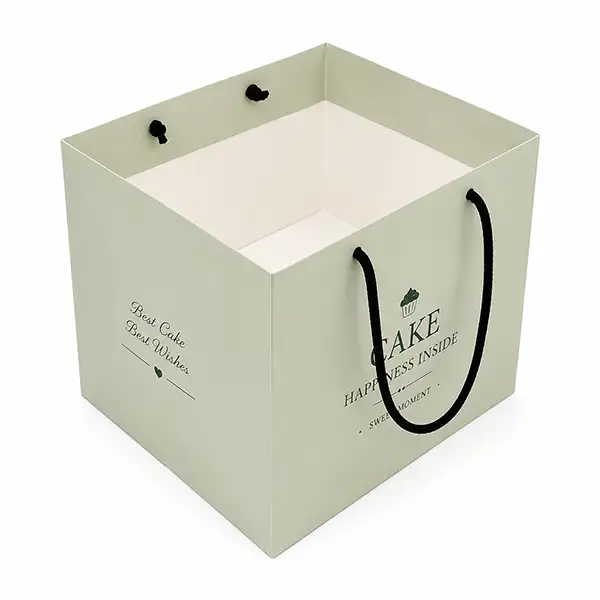
A box with a lid that shifts, a domed insert, or a display that depends on the chocolates staying in place is worth testing level first. Use the actual packed assortment for the trial. Take a few normal steps, set the bag down, remove the box, and open it to see what moved.
Choose paper and printing for the job
Kraft in natural brown or white is a useful place to start for regular counter bags. Brown can warm or mute printed colors, so approve the logo on the intended stock. White gives you a different starting point for pale colors and photographic artwork. Ask for a printed sample if the bag and box must look coordinated under the lighting in your shop. Keep the logo clear of the bottom crease, side folds, and handle area, and judge its placement with the bag open.
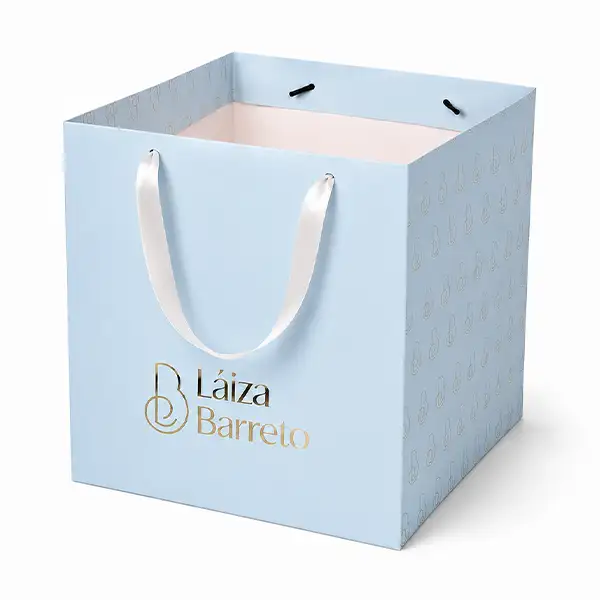
Color, a printed pattern, foil, and a contrasting handle are separate choices. Pick the detail a customer will notice first and get a sample of that finish. A dark print can show scuffs where bags rub in a stack, and a finish may look different across a fold. Open and close the sample and handle it like a bag at the counter before approving the appearance.
Paper weight in grams per square meter (gsm) tells you how much a square meter of the paper weighs. Carry performance depends on the whole bag, including the paper, handle attachment, upper edge, bottom folds, glue joints and how the load sits. If a quote includes a reinforced top or a bottom board, ask to see where it goes and try it with your heaviest normal order. Paper bag load test findings from CEPI Eurokraft
If you plan to print disposal instructions, confirm the actual paper, finish, handles, and any removable parts against the collection guidance in the market where customers will use the bag.
Check the food and delivery requirements separately
A shop carrier usually holds chocolate that is already wrapped, pouched or boxed. If unpackaged pieces will touch paper, a liner, or the inside of a bag, tell the supplier where contact occurs, what the food is, how long contact lasts, the expected temperatures, and the destination market. Request documentation for the actual contact materials and intended conditions. The type of paper or its color alone cannot establish suitability for direct contact. U.S. FDA guidance · European Commission food-contact guidance
For a short walk from the shop, the bag's main job is to carry the closed packs. For a warm delivery route, decide how the chocolates will be protected from heat and how the boxes will stay level during the journey. A regular paper carrier provides a handle and a presentation surface. If you need temperature control or ship by parcel, use a separate protective shipping setup and verify it for the route and duration. Lindt & Sprüngli on chocolate storage
Approve one loaded sample before ordering
- Open and load it at the counter. Try a typical order and the largest or heaviest planned order. Check that staff can insert the boxes in the intended orientation and finish any flap, sticker or bow.
- Lift, carry, and set it down. Inspect the bottom, glued seams, handle patches, and holes. Note any sagging, tearing, painful grip, or tipping.
- Take the gifts out and open them. Look for scuffed sleeves, crushed corners, loose lids, or shifted chocolates. Check that customers can lift the box out with their fingers around it.
- Compare the quote to the approved sample. Confirm the size, stock, printing, handle style, reinforcement, and how the finished bags will arrive and be stored. Keep the approved sample and its specification together.
This counter trial helps you find fit and handling problems. If you need a stated carrying capacity, ask the supplier for a test method, sample configuration, and conditions that support that rating.
For a first order, reserve custom printing for the bags you expect to use steadily. A plain stock bag with a branded label can also help you test a new size for a short seasonal run. Compare quotes on the same dimensions, construction, printing, quantity, packing and delivery terms, and count any work your team will do after the bags arrive.
To request a useful sample or quote, share your closed box dimensions and carrying orientation, heaviest packed order, quantities by bag size, preferred handle or finish, and delivery country and date. A photo showing the boxes arranged as staff will pack them can make the intended fit much clearer. See SLD's chocolate paper bag options · Discuss a bag sample with SLD