
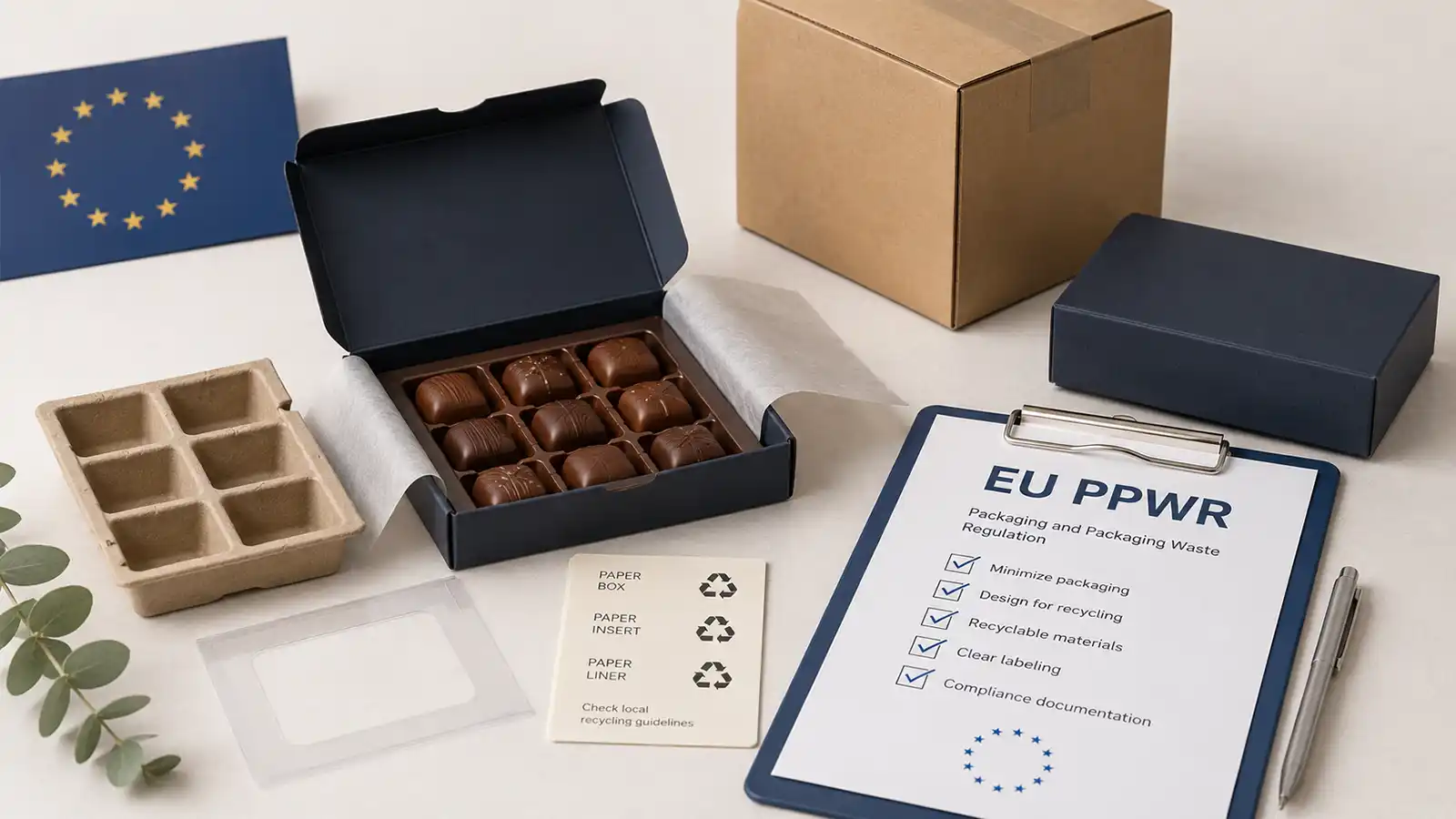
The European Union’s Packaging and Packaging Waste Regulation, Regulation (EU) 2025/40, is commonly known as the PPWR. It generally applies from 12 August 2026 and covers packaging placed on the EU market regardless of its material or country of origin.
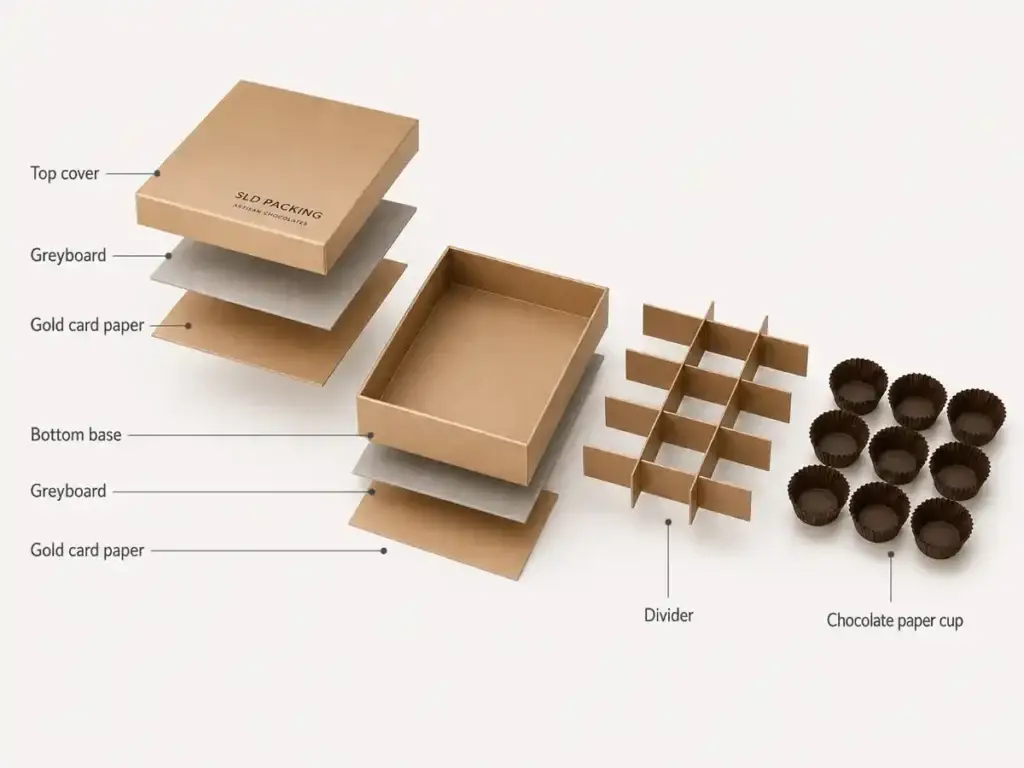
For chocolate brands, importers and packaging buyers, PPWR compliance should cover the complete packaging system, not only the visible outer box. This may include:
- Outer folding carton or rigid gift box
- Paperboard or plastic insert
- Greaseproof paper or food-contact liner
- Plastic tray, window or protective film
- Labels, stickers, ribbons and decorative accessories
- Grouped cartons and e-commerce shipping boxes
The main objective is to ensure that packaging is safe, material-efficient, recyclable and supported by reliable technical documentation.
Last updated: 11 August 2026
PPWR Implementation Timeline for Chocolate Packaging
| When | Main PPWR requirement | What chocolate businesses should do |
|---|---|---|
| 12 August 2026 | General PPWR application begins. Food-contact PFAS limits apply, heavy-metal limits continue, packaging must be recyclable, and conformity documentation is required. | Map every packaging component, identify the responsible manufacturer or importer, and collect material specifications and compliance evidence. |
| 12 February 2028 | Empty space in sales packaging must be reduced to the minimum necessary for packaging functionality and product protection. | Review box dimensions, cavity spacing and inserts. Keep evidence showing why the selected space is necessary. |
| 12 August 2028 or later | Harmonised EU material-composition and sorting labels become mandatory. The actual date may be later if the implementing act enters into force later. | Reserve artwork space, keep files editable and wait for the official EU symbols before printing them. |
| From 1 January 2030, or later where specified | Detailed design-for-recycling grades, minimum recycled-content targets for plastic packaging and stricter packaging-minimisation requirements begin to apply. | Simplify structures, reduce unnecessary layers and obtain polymer, weight and recycled-content data for plastic components. |
| 1 January 2030 or three years after the empty-space methodology enters into force, whichever is later | Grouped, transport and e-commerce packaging must not exceed a 50% empty-space ratio. | Right-size shipping cartons and reduce void fill. Paper filling, bubble wrap, air pillows and foam count as empty space. |
| From 1 January 2035 or later | Packaging must also be recyclable at scale, based on actual collection, sorting and recycling performance. | Reassess packaging against the EU methodology and available recycling infrastructure. |
Dates described as “or later” depend on delegated or implementing acts. The Commission’s implementation calendar also contains deadlines for issuing those acts, but an act-development deadline is not necessarily the same as the date businesses must comply. As of 11 August 2026, the Commission was still preparing the harmonised packaging-labelling implementing act and the methodology for calculating plastic recycled content.
1. Assess the Complete Packaging System
Begin with a packaging bill of materials that identifies every component used to pack and deliver the chocolate.
For each component, record:
- Material and coating composition
- Component weight
- Supplier and material reference
- Direct or indirect food-contact status
- Whether it can be separated from other materials
- Intended disposal or recycling route
- Recycled-content percentage, where applicable
Do not assess only the paper box while excluding the tray, liner, window, label or shipping carton. A packaging claim or compliance conclusion based on only one visible component can be misleading.
The business that physically manufactures the packaging is not always the legally responsible manufacturer under the PPWR. Depending on the supply chain, a brand owner that places packaging on the market under its own name or trademark may carry the manufacturer’s obligations. Importers also have specific verification duties.
A packaging supplier can provide drawings, declarations and test reports, but the responsible manufacturer or importer must ensure that the final packaging is compliant and that the documentation matches the approved construction.
2. Control Food-Contact Safety, PFAS and Heavy Metals
PPWR compliance does not replace existing EU food-contact-material legislation.
Materials intended to contact chocolate must still comply with the applicable food-contact requirements, including:
- Regulation (EC) No 1935/2004
- Regulation (EC) No 2023/2006 on good manufacturing practice
- Regulation (EU) No 10/2011 for plastic food-contact materials
This may affect trays, flow-wrap films, coatings, adhesives, inks, inserts and chocolate greaseproof paper.
A general statement that a material is “food grade” is not sufficient on its own. The supporting documents should relate to the material’s actual use, including food type, contact time and temperature. Relevant declarations of compliance, specifications and migration tests should be requested where applicable.
Heavy-Metal Limit
The combined concentration of the following four heavy metals in packaging or packaging components must not exceed:
Lead (Pb) + Cadmium (Cd) + Mercury (Hg) + Hexavalent Chromium [Cr(VI)] ≤ 100 mg/kg
The 100 mg/kg limit applies to the combined total, not separately to each metal.
Testing and supplier declarations should cover the complete packaging construction where relevant, including paperboard, recycled fibres, inks, coatings, plastic components, metallic decorations and adhesives.
PFAS Limits for Food-Contact Packaging
From 12 August 2026, food-contact packaging placed on the EU market must remain below the following PPWR thresholds:
- Below 25 ppb for any individually measured targeted PFAS, excluding polymeric PFAS from this calculation
- Below 250 ppb for the sum of targeted PFAS, excluding polymeric PFAS from this calculation
- Below 50 ppm for total PFAS, including polymeric PFAS
PFAS control is particularly relevant to paper and board with grease-resistant, oil-resistant, moisture-resistant or stain-resistant treatments.
Businesses should determine which components are legally considered food-contact packaging. For example, a greaseproof liner or tray touching unwrapped chocolates is different from a decorative outer box containing individually wrapped products.
Do not assume that packaging manufactured before 12 August 2026 receives an automatic unlimited sell-through period. Food-contact packaging first placed on the EU market after that date must comply with the applicable PFAS limits.
Practical controls:
- Ask whether fluorinated substances are intentionally used.
- Obtain a PFAS statement linked to the exact material reference.
- Arrange testing where the coating chemistry or recycled-material source is uncertain.
- Prevent unapproved substitutions of coatings, paper mills, inks or adhesives.
3. Design the Complete Packaging for Recycling
PPWR requires packaging placed on the EU market to be recyclable. More detailed EU design-for-recycling grades and assessment methods will apply from 2030 or later, following the relevant delegated acts.
Chocolate packaging should therefore be reviewed both by individual component and as a complete unit.
Practical design measures include:
- Using the simplest structure that provides adequate protection
- Reducing unnecessary combinations of paper, plastic, foam and metal
- Making trays or windows removable when separation is needed
- Avoiding large, permanently bonded non-paper layers
- Reducing unnecessary full-surface plastic lamination
- Recording coatings, adhesives and decorative materials accurately
- Avoiding components that cannot be separated and have no protective function
A package is not automatically recyclable because the outer surface is paper. Full-surface films, bonded foam inserts, magnetic closures, plastic trays and metallic layers can affect the final assessment.
At the same time, a premium rigid box is not automatically non-compliant. Its compliance depends on the exact construction, component weights, separation method and applicable recycling criteria.
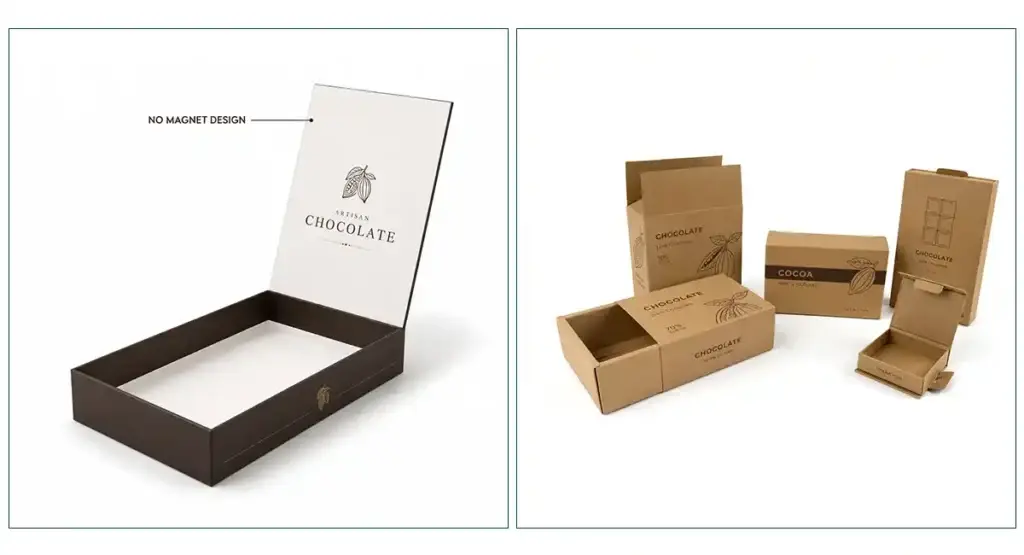
Whether developing chocolate folding boxes or more substantial chocolate gift boxes, the assessment should be based on the approved production specification rather than a general description such as “paper box.”
4. Reduce Unnecessary Material and Empty Space
Packaging must protect chocolate against movement, crushing, contamination and damage. PPWR does not require businesses to remove packaging that is genuinely necessary for product safety or protection.
However, packaging should not use unnecessary weight, volume or empty space simply to make the product appear larger.
Potentially problematic features include:
- Oversized boxes with small quantities of chocolate
- Cavities substantially larger than the products
- False bottoms
- Unnecessary double walls
- Decorative layers with no protective or structural purpose
- Oversized shipping cartons filled with paper, foam or air pillows
Premium presentation can remain part of a chocolate product, but presentation alone does not justify excessive material or misleading volume.
The selected packaging dimensions should be supported by practical evidence such as:
- Product and cavity dimensions
- Packing-line requirements
- Compression or drop tests
- Transit testing
- Shelf-life and barrier requirements
- Written explanations of necessary clearance and protection
From 12 February 2028, empty space in sales packaging must be reduced to the minimum necessary for functionality, including product protection.
For grouped, transport and e-commerce packaging, a maximum empty-space ratio of 50% will apply from the later of the specified dates. Void-fill materials—including paper cuttings, bubble wrap, air cushions, foam and wood wool—are treated as empty space rather than product volume.
For online chocolate orders, the sales box and outer custom chocolate corrugated box should be developed together. A correctly sized transport carton normally reduces both packaging material and the amount of protective filling required.
5. Review Plastic Trays, Windows and Films
Plastic trays, windows, films and protective components may be affected by future minimum recycled-content requirements.
From 1 January 2030 or later, depending on the relevant implementing measures, the main targets include:
- 30% recycled content for contact-sensitive PET packaging
- 10% recycled content for other contact-sensitive plastic packaging
- 35% recycled content for other plastic packaging
The classification must be assessed carefully. A PET tray in direct contact with chocolates, a plastic window that does not touch the product and a transport film may not fall into the same category.
Certain exemptions may apply, including food-contact situations where recycled content would create a health risk or conflict with EU food-contact requirements. Exemptions should be supported by evidence rather than assumed automatically.
For every plastic component, record:
- Polymer type
- Component weight
- Direct or indirect food-contact status
- Recycled-content percentage and source
- Relevant food-contact documents
- Migration or safety testing, where applicable
Replacing plastic with paper is not automatically the best solution. The alternative material must still provide suitable grease resistance, barrier performance, product protection and end-of-life recyclability.
6. Prepare Packaging Artwork for EU Labels
PPWR introduces harmonised EU labels showing packaging material composition and supporting correct consumer sorting.
The labelling requirement will apply from 12 August 2028 or 24 months after the relevant implementing act enters into force, whichever is later.
Because the Commission was still preparing the detailed labelling act as of 11 August 2026, businesses should not assume that unofficial symbols currently offered by designers, software tools or suppliers will satisfy the final requirement.
To prepare packaging artwork:
- Reserve a reasonable area for future material and sorting information
- Keep original artwork files editable
- Maintain accurate material data for each component
- Do not print unofficial “PPWR-compliant” symbols
- Review national sorting-label rules during the transition period
- Recheck the final EU implementing act before approving long production runs
Where separate chocolate stickers and labels are used, include the label face material, ink, adhesive and release liner in the packaging-material assessment.
7. Build a Technical File for Every Approved Packaging Structure
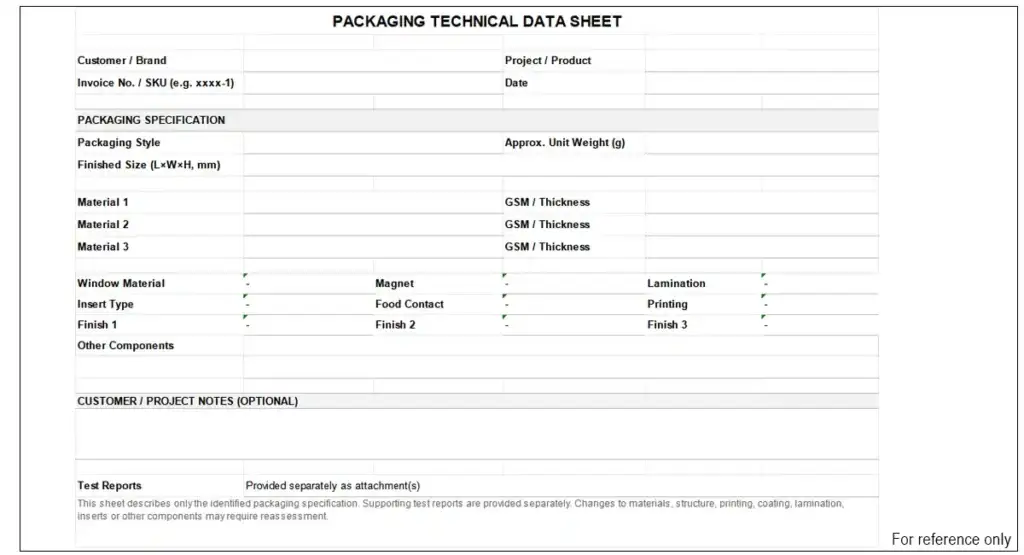
PPWR compliance should be supported by a technical file linked to the final approved packaging.
The file should normally contain:
- Structural drawings and finished dimensions
- Complete packaging bill of materials
- Individual component weights
- Paper, board, plastic, coating, ink and adhesive specifications
- Food-contact declarations and test reports
- Heavy-metal and PFAS evidence
- Recyclability and separation assessment
- Packaging-minimisation and empty-space rationale
- Plastic recycled-content evidence, where applicable
- Approved artwork and labelling records
- Supplier, batch and production traceability
- EU Declaration of Conformity
Technical documentation should normally be retained for five years for single-use packaging and ten years for reusable packaging after the packaging is placed on the market.
A generic report stating that “paper is recyclable” or “material is food grade” is not enough. Documents should identify the actual material grade, supplier, coating, adhesive, ink and intended use.
Supplier change control is equally important. A change in paper mill, recycled-fibre content, plastic resin, coating formulation, lamination, ink, adhesive or recycled-content source can affect the original assessment.
No material substitution should be approved until its impact on food contact, PFAS, heavy metals, recyclability and documentation has been reviewed.
8. Use Environmental Claims Carefully
Claims such as the following should not be used without clear supporting evidence:
- Eco-friendly
- Sustainable packaging
- Plastic-free
- 100% recyclable
- Fully compliant with PPWR
The claim should state whether it relates to the complete packaging unit or only one component.
For example:
More precise: “The outer paperboard box is recyclable where appropriate collection and recycling systems exist.”
This is more accurate than claiming that the entire package is 100% recyclable when it also contains a plastic tray, laminated insert, ribbon or bonded accessory.
Environmental claims concerning recyclability, recycled content or other PPWR-regulated properties should be specific, verifiable and supported by the technical documentation.
9. Do Not Overlook National EPR Obligations
PPWR product conformity does not replace national extended producer responsibility, or EPR, obligations.
Depending on the sales model, the responsible producer may need to:
- Register in the relevant EU Member State
- Report quantities and materials placed on the market
- Join a producer responsibility organisation
- Pay packaging-related fees
- Appoint an authorised representative where required
These obligations are especially important for brands selling directly to consumers in several EU countries. The responsible party for EPR purposes may not always be identical to the manufacturer responsible for packaging conformity, so the two assessments should be completed separately.
Final PPWR Checklist for Chocolate Packaging
Before approving mass production, confirm that:
- Every packaging component is included in the bill of materials.
- The responsible manufacturer, importer and EPR producer have been identified.
- Direct and indirect food-contact components have appropriate documentation.
- Pb + Cd + Hg + Cr(VI) have a combined total of no more than 100 mg/kg.
- Food-contact packaging meets the applicable PFAS limits.
- The complete structure has been reviewed for recyclability and material separation.
- Box dimensions, inserts and empty space are necessary for product protection.
- Plastic type, weight and recycled-content information are available.
- Artwork remains editable for future EU sorting labels.
- The technical file matches the final approved materials and suppliers.
- Material substitutions require documented review and approval.
- Environmental claims are precise and supported by evidence.
Conclusion
Preparing chocolate packaging for PPWR is not simply a matter of changing plastic to paper or adding a recycling symbol.
A reliable compliance process should control:
- The complete packaging structure
- Food-contact safety
- PFAS and heavy metals
- Recyclability and material separation
- Packaging weight and empty space
- Plastic recycled content
- Labelling and artwork
- Technical documentation and traceability
The most effective time to address these requirements is during structural and material development, before tooling, artwork and mass production are approved.
For a new packaging project, provide the supplier with the chocolate dimensions, packing method, food-contact layers, required shelf life, target EU markets and transport conditions. You can also review our packaging support capabilities or contact our team to discuss packaging structure, materials and supporting documentation.
Regulatory note: This article provides general packaging information and does not constitute legal advice. PPWR requirements continue to be supplemented by delegated acts, implementing acts, harmonised standards and national EPR rules. Final compliance should be assessed for the specific packaging construction, intended use and target market.